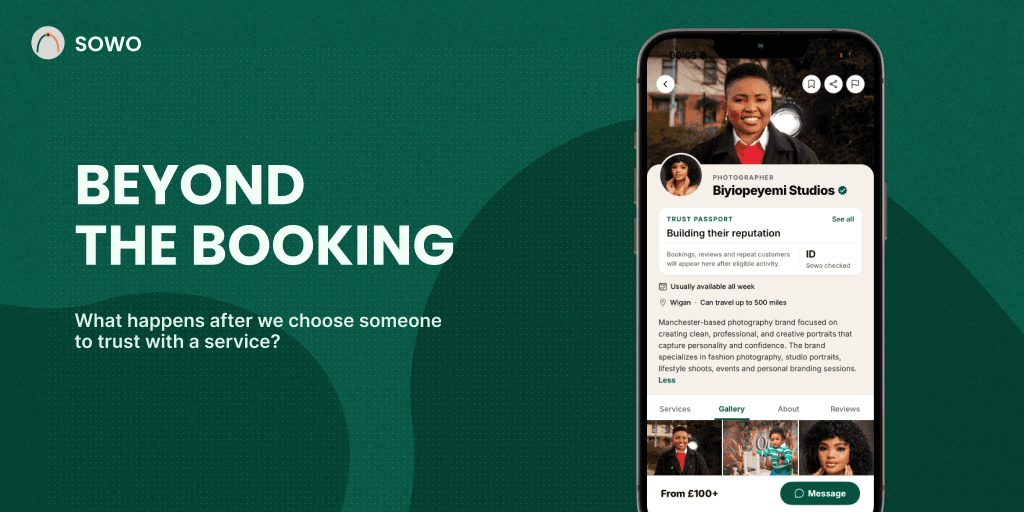
Why reviews aren’t enough

Reviews tell you what happened. They rarely tell you how well you know the person who left them, or whether they ever paid for anything.
Most marketplaces treat a five-star average as proof. But a rating is only as good as the process behind it, and for a lot of platforms that process is: anyone can leave a review, about anything, at any time. That is a weak foundation to hand someone your money and your front door.
Anonymous ratings are easy to move
When a rating isn’t tied to a real transaction, there is nothing underneath it to check. A profile with fifty five-star reviews and a profile that quietly bought fifty of them look identical from the outside.
The common ways ratings get moved:
- Reviews from people who never booked or paid.
- Bought reviews, ordered in bulk from someone who was never a customer.
- Review-gating, where only the happy customers are ever asked, so the average is curated.
- Competitor attacks, where the bad reviews are as fake as the good ones.
The problem isn’t that reviews are useless. It’s that a rating detached from a transaction carries no weight you can verify.
A review tied to a real booking is a stronger claim
On Sowo, a review can only come from a completed, paid booking or order. When you book, your payment is authorised and held by Stripe and released to the provider once you confirm the work is done. The review comes after that. So a profile can’t be padded with ratings from people who never hired the provider.
This won’t stop every bad experience, and it doesn’t claim every review is fair. It removes the cheapest and most common fake: the review from someone who was never there.
Repeat customers carry more weight than one-off stars
A single review reflects a single experience. Someone who books the same provider a second and third time is telling you something a first-timer can’t: that the work held up, and they came back.
On Sowo, a repeat customer can add a named vouch. A person willing to put their own name to a recommendation, after more than one paid booking, is a much harder signal to manufacture than an anonymous star.
How the Trust Loop builds a Trust Passport
None of these mechanisms does much on its own. What matters is that they connect, each step depending on the one before it. We call it the Trust Loop:
- A provider is reviewed by our team before their profile goes live, and can verify their identity to earn the verified seal.
- A customer books, and the payment is held by Stripe.
- The provider completes the work.
- The customer confirms, and the payment is released.
- That completed, paid booking is what produces a review.
- A repeat customer can add a named vouch.
- All of it accumulates into the provider’s Trust Passport.
A Trust Passport is the record that grows out of this loop: verified identity, completed jobs, reviews tied to real bookings, and named vouches from people who came back. Because each part is earned through a real transaction, the whole thing is slow to build and hard to copy.
What Sowo can and cannot verify
Being straight about the limits is part of the point. Here is where the line sits.
What we can verify
- That a provider was reviewed by our team before their profile went live, and whether they have verified their identity.
- That a booking was really paid for and marked complete.
- That every review and vouch is attached to one of those real bookings.
- That a vouch comes from a customer who booked more than once.
What we don’t claim to verify
- That every job is done well. A real, paid booking can still end in a review you’d rather not read, and we show those too.
- That a provider will always deliver. History is a guide, not a guarantee.
- Personal fit and taste, which no rating can settle for you.
That last group is why we don’t hide negative reviews or round the numbers up. A trust record you can’t fully believe is worse than no record at all.
“Trust isn’t a number you can inflate. It’s a record you build, one completed job at a time.”
That is the marketplace we’re building: not the one with the most reviews, but the one where every review means something.